
How to Find a CTO for Startup: Best Practices, Cost, and Skills
The success or failure of your startup hangs in the balance when it comes to choosing a CTO. And sometimes, having a tech leader who “gets it” can help you to work through early-stage finance, product-market fit and scaling challenges faster, or can make it harder.
Let’s take a look at the costs, skills, and best practices you need to consider when recruiting a CTO:
What Does a CTO Do in a Startup?
A startup CTO is responsible for more than just the other employees of an IT company. They often help developers to code, pick the tech stack, and build the MVP. When technical issues come up, the CTOs pitch to investors.
A startup CTO has to:
- Design and validate scalable architecture
- Make critical decisions
- Lead hiring and team culture
- Make sure the service is secure and compliant
- Synchronize the company business goals with a tech roadmap
When Should You Hire a CTO?
Once your product has been validated and you need to scale, or if you are looking for institutional finance, the CTO becomes fundamental. This is especially essential for SaaS, AI, healthtech, or deep tech companies: investors often want to make sure that a seasoned tech executive is in control.
This happens frequently: Startup goes from dev shop or freelance developer. Then they get some traction, seed money, and realize that a certain someone needs to become the full-time leader of their tech vision. Then they hire a CTO, who could be a part-time officer, an early employee, or a co-founder.
Read: Custom Laser Engraving: A Niche Market With Big Potential
What Does It Cost to Hire a CTO?
There’s no such thing as one size fits all when it comes to price, but here’s an approximate breakdown based on a few different arrangements:
- Co-founder CTO: Most of the time they’ve got equity (10–35%) instead of a full salary. Start-ups may provide a deferred compensation.
- Full-time CTO: $150K–$300K+ per year based on experience and location.
- Fractional CTO: $5K–$20K/month. Great for startups who are looking for strategic insight but don’t need someone full time.
- Off-site CTO or Tech Lead: Either Project-based fee or monthly retainer. Used in the MVP or transition.
Hiring globally can reduce costs. A senior CTO located in Central and Eastern Europe or Latin America could provide a comparable level of strategic value at a lower price, but make sure they’re aligned with your vision, not just your time zone.
What Are the CTO Skills You Should Look For?
Startups require CTOs who can move quickly and have long-term vision. The great ones are not simply coding wizards: they are visionaries, communicators, team builders.
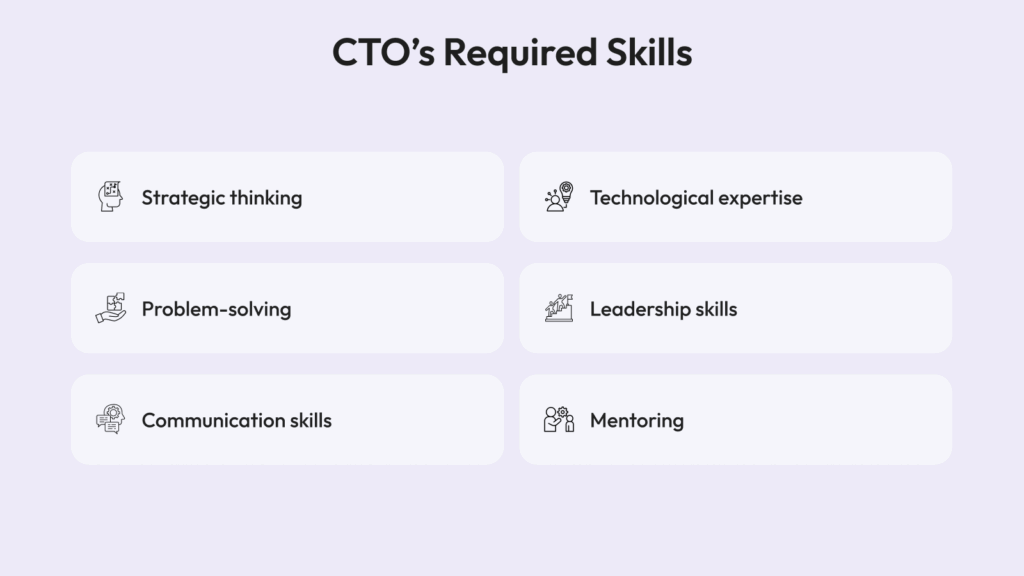
Must-have skills of CTOs for your company:
- Strong hands-on experience with relevant tech stack(s) such as Python, Node. js, React, AWS)
- Experience shipping products at scale
- Knowledge of DevOps, CI/CD and cloud architecture
- Strong leadership and mentoring ability
- Business acumen: mentoring that can translate some technical tradeoffs into business decision-making.
Bonus skills of CTO for your startup are the following:
- Fundraising experience or investor relations
- Experience with: compliance (e.g. HIPAA for healthtech)
- UI/UX emphasis (in particular for B2C product)
- Familiarity with Agile/Scrum practices
Where Should You Look for the Right CTO?
Good CTOs are usually found through networks — not job boards. Here’s where a lot of startups get their CTO:
- Founder communities (e.g. Y Combinator’s forum, Indie Hackers, Product Hunt)
- Cold-linked email with personal touch for example trainers.
- Tech meetups and hackathons
- AngelList (now Wellfound) or Toptal.
- Accelerators and incubators
Some founders go so far as poaching talent directly from startups with similar stacks but slower growth. If somebody has built a great product for another company, maybe they’d be ready to do it for yours, especially if you would give them equity in your company and a chance to be a co-founder.
Best Practices for Hiring a CTO
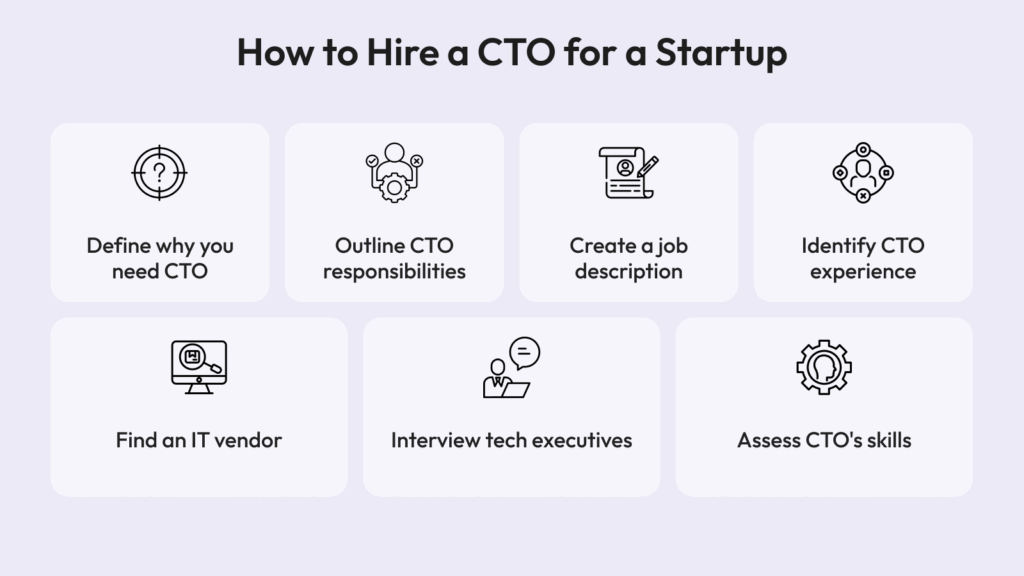
Align on vision early
Before code, comes alignment. Make sure your candidate is invested in your startup’s mission. Ask them where they think your tech might be in 3 years. If what they want and how they want it to look once it’s done doesn’t jibe with your vision of the final look and feel, that’s a red flag.
Vet through trial projects
Don’t rely solely on interviews. Give them a tiny but real-world task: reviewing your codebase, scoping a feature, or providing feedback on your architecture. Observe how they think, not only how they talk.
Use founder-investor references
If they’ve been at other startups, chat with past co-founders or investors. Find feedback on leadership, reliability and pressure.
Make equity and risk clear
Not all world-class developers want to be a startup CTO. Some would rather have cushy salaries than high-stakes equity. Be open about what you’re offering, both the risk and the upside.
Culture fit is a key
If your startup is fast-moving, you really want to hire someone who thrives in chaos. And if you’re with a remote team, your CTO needs to over-communicate. Get this wrong and it won’t matter how good their code is.
Final Thoughts
When you hire a CTO for your startup, you’re less concerned with checking off technical boxes and more focused on finding a partner in vision and execution. The best CTOs when used right become part of the brand, the startup, the product, they become the people who grow with the brand, the company, the people who grow with the product.
Whether you’re bringing someone on full time, part time or as a cofounder, shift your focus away from contractual agreements and towards alignment, flexibility and a long-term mentality. Tech will change. Tools will evolve. But a great leader can guide you through every pivot that follows. Understanding the startup CTO roles and responsibilities is crucial to finding someone who can scale both your tech and team from day one.